
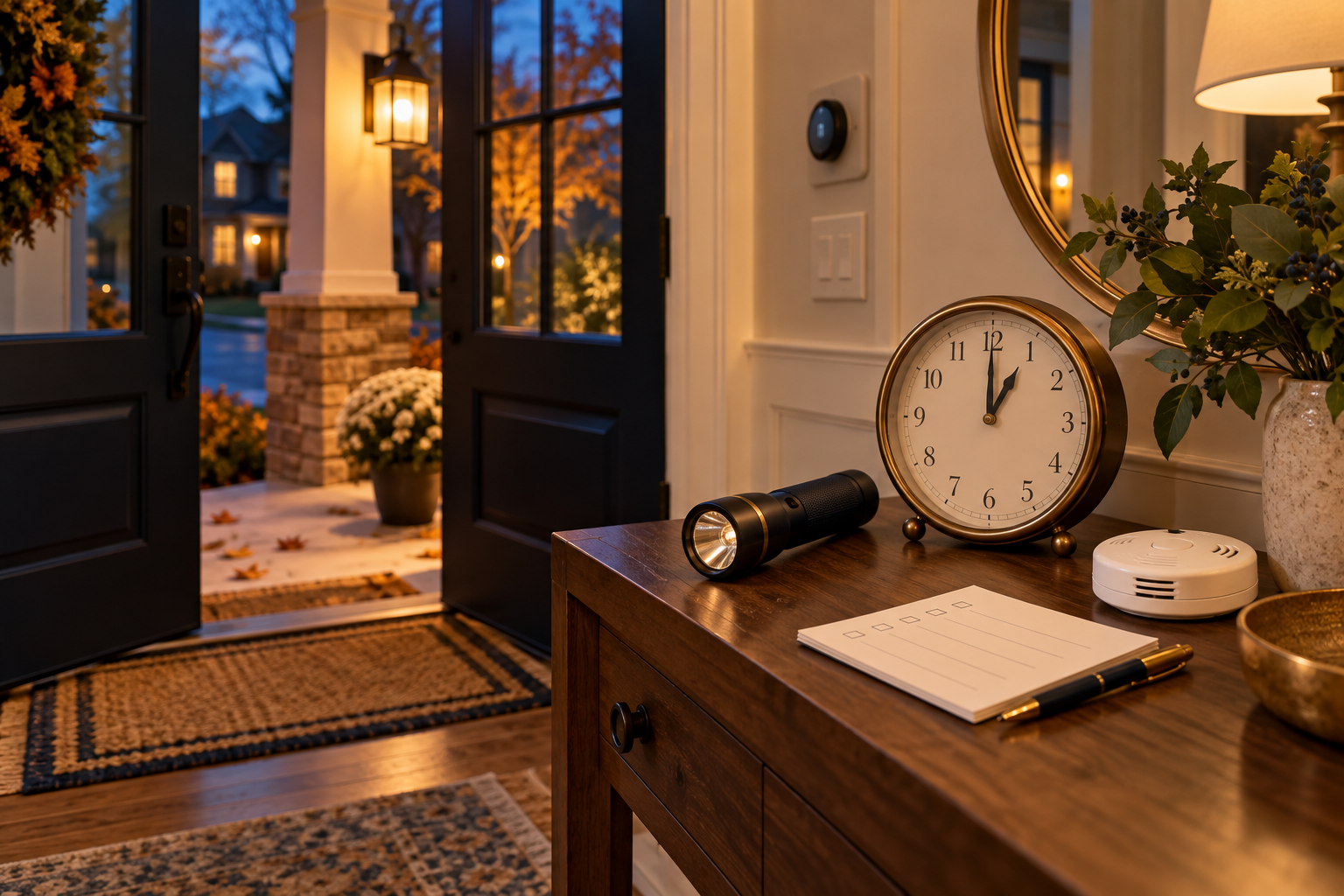
This weekend, many U.S. households will turn clocks back one hour. Rather than spending that “extra” hour scrolling, borrow 30 minutes for a calm little home reset. If you live where daylight saving time is not observed, the checklist still works as an early-November reset.
In places that observe daylight saving time, it ends Sunday, November 1, 2026, at 2:00 a.m. local time, when clocks move back to 1:00 a.m. Many phones and computers update automatically, but wall clocks, appliance clocks, irrigation controllers, security systems, and some thermostats may not.
1. Reset clocks and routines — 5 minutes
Check the oven, microwave, wall clocks, car, irrigation controller, security cameras, and smart-home routines. For devices designed to change automatically, confirm the time zone and daylight-saving setting instead of forcing the clock manually.
2. Test the alarms — not only the batteries — 10 minutes
Press the test button on every smoke and carbon-monoxide alarm. NFPA and CPSC guidance calls for monthly alarm testing. Smoke alarms should generally be replaced when they are 10 years old. Replace batteries only as the manufacturer directs; many sealed 10-year models require replacement of the entire unit when they chirp or reach end of life.
If an alarm is missing or outdated, follow current placement guidance and the manufacturer’s instructions. Carbon-monoxide sensor lifetimes vary, so use the replacement date on the device or in its instructions rather than relying on a single age rule.
3. Walk the path after dark — 5 minutes
Step outside and look at the route from the driveway or sidewalk to the door. Check the front steps, walkway, house numbers, side or garage entry, loose bulbs, trip hazards, and shrubs that may block light. Earlier sunsets can expose timer settings that worked in summer but no longer help. Adjust timers, photocells, and motion sensors so the walking surface is visible without shining light into a neighbor’s home.
4. Check the thermostat and “away” routines — 5 minutes
Confirm that the thermostat shows the correct time and that weekday, weekend, sleep, and away schedules still match real life. Department of Energy guidance supports programming around when the household is home, away, or asleep. Also check any door-light or smart-home routines tied to a clock.
A useful five-minute bonus
Choose a family meeting place for a fire escape plan and keep a working flashlight where it is easy to reach. If the home uses fuel-burning heat or a fireplace, arrange recommended annual service and keep working carbon-monoxide alarms. A portable generator should always stay outdoors, at least 20 feet from the home, with exhaust directed away from windows and doors.
The bottom line
An extra hour does not have to become another project. Four small checks can make darker evenings calmer, safer, and a little more comfortable.
This article provides general educational information. Follow manufacturer instructions, local codes, and qualified professional guidance for your home. Most of the United States observes daylight saving time; Hawaii, U.S. territories, and most of Arizona do not.
Thinking about buying, selling, or planning your next move? I’m always happy to help you think it through.
Authoritative sources and references
- NIST — Daylight Saving Time Rules
- U.S. Department of Transportation — Daylight Saving Time
- American Red Cross — Test Your Smoke Alarms as You Turn Back Your Clocks
- NFPA — Smoke Alarms
- U.S. Consumer Product Safety Commission — Carbon Monoxide Alarms
- U.S. Consumer Product Safety Commission — Protect Your Family from Carbon Monoxide Poisoning
- U.S. Department of Energy — Programmable Thermostats
- U.S. Department of Energy — Exterior Lighting Controls
- Virginia Real Estate Board — Advertising by Licensees
- Virginia DPOR — Fair Housing Advertising